
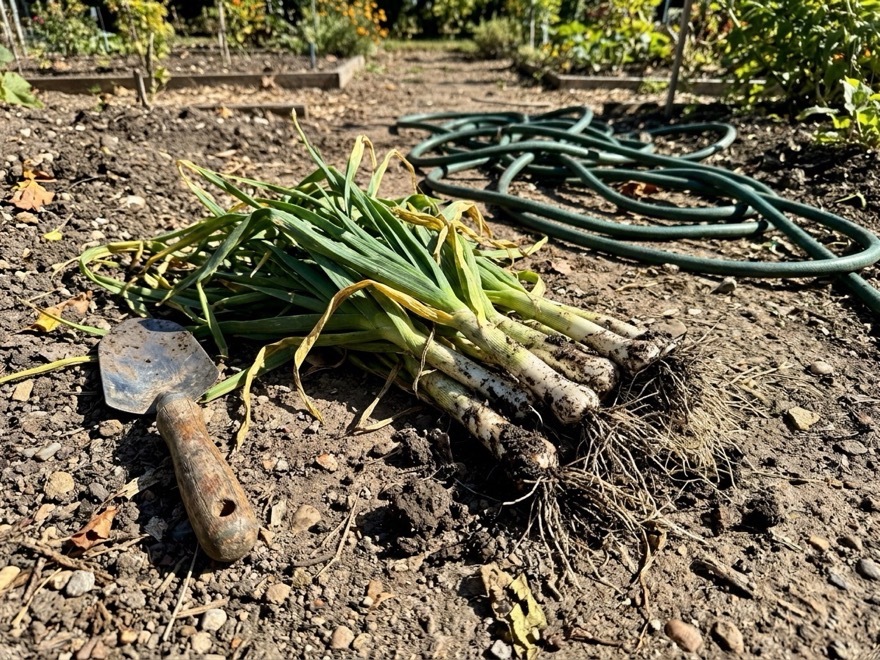
You see a thick, long white stem at the market and think, I want that in my garden. But is it a leek or a scallion? The answer decides when you plant, how long you wait, and how much soil you pile around the stem. Here is how a leek vs scallion compares, and how to grow each one. If you garden with little space or money, see our guide to growing vegetables with limited resources.
TL;DR: In a leek vs scallion choice, the leek is the bigger, slower crop with a stem over an inch wide. A scallion grows faster and thinner, but a negi-style scallion can also get a thick white base.
Leek vs scallion: the main differences
A leek is a large, slow crop with a flat leaf and a thick white shaft. A scallion is a bunching onion that grows quickly and stays slimmer. Both are alliums, and neither forms a big round bulb.
University of Minnesota Extension says leeks look like overgrown green onions with a long white shaft. Unlike onions, leek tops do not die back as the crop matures.
How to grow thick scallions (negi style)
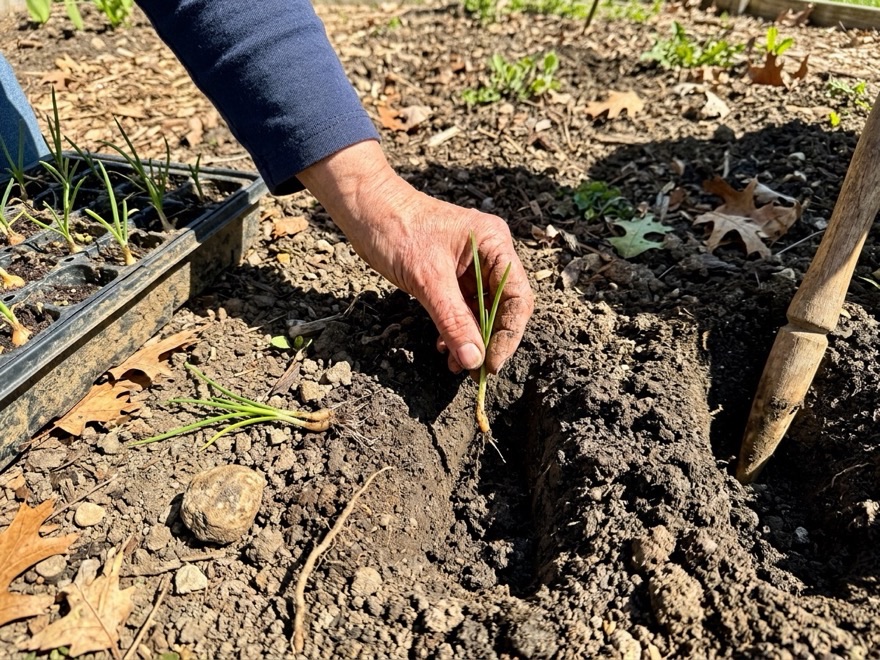
Negi-style scallions are bunching onions grown for a thick, long white base. The method is the same idea as leeks: start in flats, transplant, and bury the stem.
- Start seed in flats. Johnny's Selected Seeds says Negi-style scallions with a thicker blanched portion should be started in flats.
- Transplant when pencil-thick. Move plants out when they are 8 to 18 inches (20 to 45 cm) tall and as thick as a pencil.
- Dibble deep holes. Make holes about 6 inches (15 cm) deep, 6 inches apart, in rows 24 inches (60 cm) apart. Drop one plant in each hole and do not firm the soil. Water settles it.
- Hill the stems. Pull soil up around the plants 2 or 3 times, higher each time. The buried part stays white and tender.
The dibble method reduces or removes the need for hilling. Aim for a soil pH of 6.2 to 6.8.
Count on roughly 10 to 15 days less from a transplant than from direct seeding. A thin crop can be ready in about 60 days.
How to grow leeks
Leeks take longer, but they are not hard. Set transplants at the bottom of a trench about 6 inches (15 cm) deep, then fill it in as the plants grow. University of Minnesota Extension advises 2 to 6 inches (5 to 15 cm) between plants. Leave 12 to 36 inches (30 to 90 cm) between rows.
Hilling soil or compost around the plants during the season gives the long white shaft. Pull soil up before it covers the leaf fan.
Most leeks are ready when the stem is bigger than 1 inch (2.5 cm). A good leek has a firm white shaft over 3 inches (7.5 cm) long. Harvest by loosening the soil and lifting the plant.
Leeks handle frost well. Some survive down to 20 degrees F (minus 7 degrees C). Mounding mulch around them stretches the season into late fall. Our guide to planting vegetables for winter shows what else to grow in the cold months.
Which one should you plant?
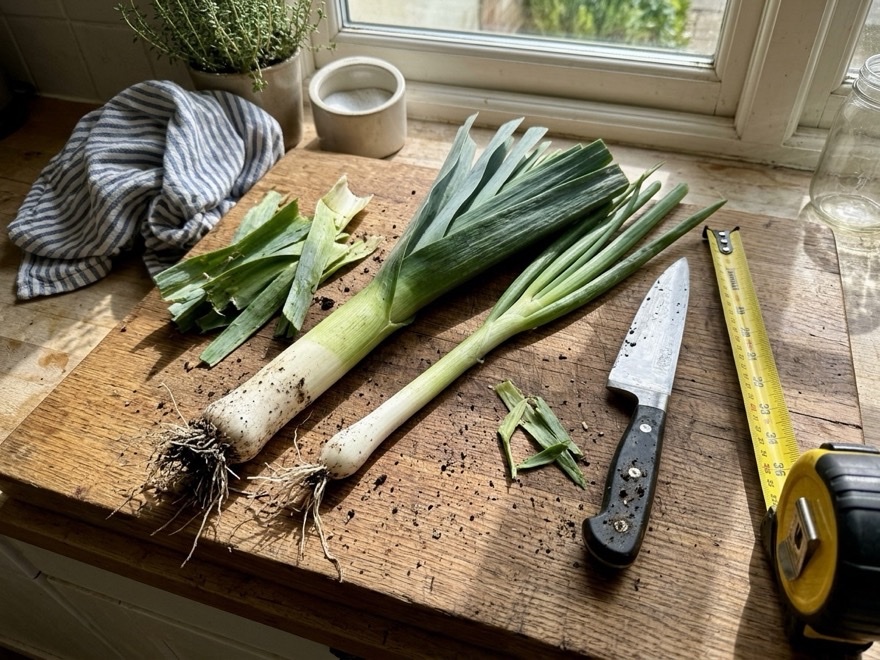
Pick scallions if you want something on the plate in two months. They suit small beds, containers, and a crop you cut a little at a time. A balcony bed works well, as in our balcony vegetable garden guide.
Pick leeks if you have the room and the patience. They give the thickest stems and stay in the ground through fall. They fit gardens where the season is long.
Pick negi-style scallions if you want a thick white base without the long wait of a leek.
If you have the space, grow both. In USDA zone 5, zone 6, and zone 7, sow seed in flats in late winter and transplant in spring. Our garden planting schedule guide explains how to find your dates.
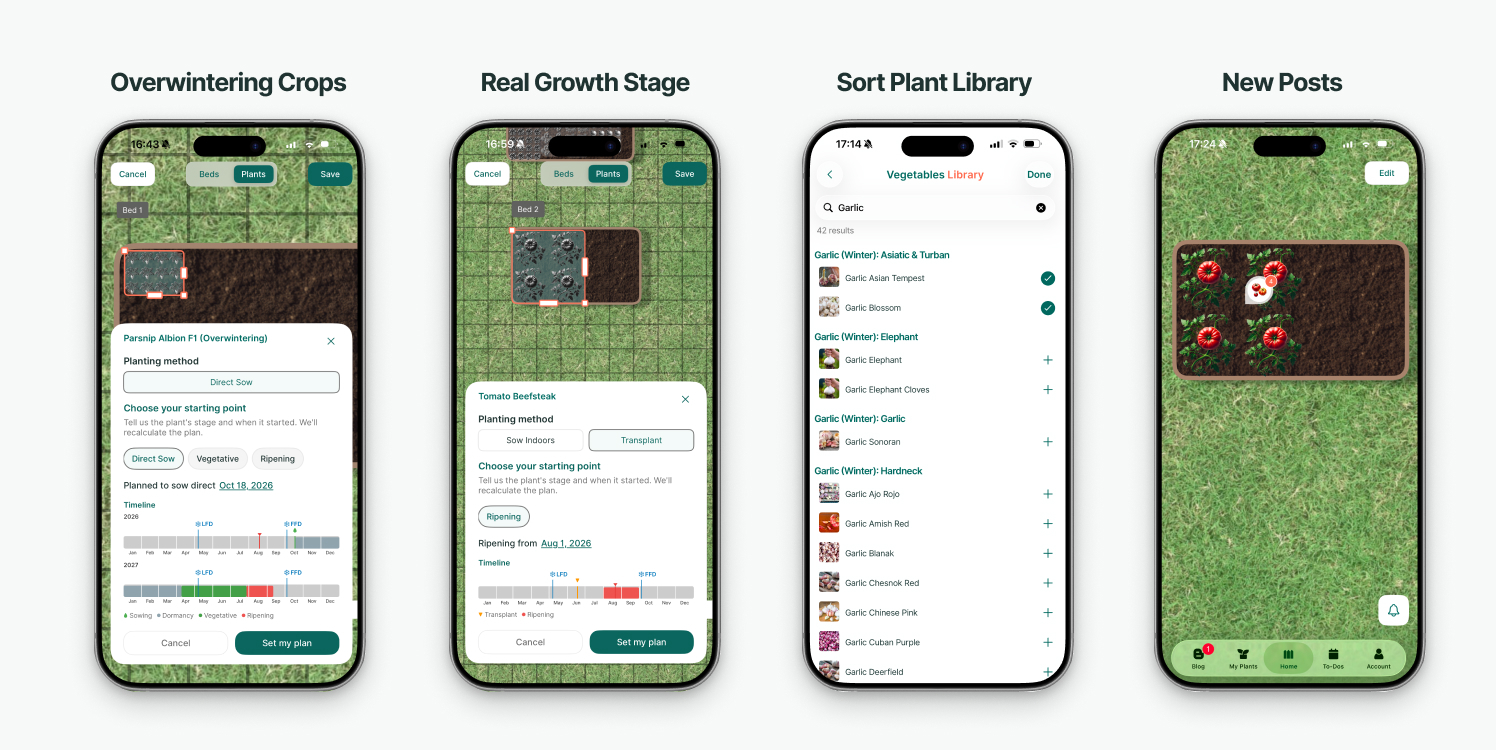
Both crops need a head start indoors, and the dates depend on your last frost. easyDacha is a gardening app that calculates your planting dates from your ZIP code and your local frost dates. It builds a care plan for each plant and a two-week task list. Download easyDacha and add your onions.
What NOT to do
Do not bury the leaf fan. Hill up to the base of the leaves, not over them. Soil in the center can rot the plant.
Do not firm the soil in the dibble hole. Water and rain settle it on their own.
Do not expect a leek in 60 days. Leeks need several more weeks than scallions.
Do not let the white stem see sun. The covered part stays white. Exposed stem turns green.
When your onions stay thin
Thin stems usually come from three things. Plants set too close share the same soil, so check your spacing. Too little hilling leaves the white part short. Weak soil slows growth, so check pH and feed. If leaves turn yellow, see why onions turn yellow.
Get your onion dates right
Start the right crop on the right day. easyDacha, a vegetable garden app, gives you planting dates for your ZIP code and a task list for the next two weeks. Try easyDacha and plan your beds.
FAQ
What is the difference between a leek and a scallion?
A leek is a large, slow crop with a flat leaf and a stem over 1 inch (2.5 cm) wide. A scallion is a faster bunching onion with a slimmer stem. Neither forms a big bulb.
Can I grow thick scallions?
Yes. Start Negi-style scallions in flats, transplant at 6 inches (15 cm) spacing into deep holes, and hill the stems 2 or 3 times.
Are scallions and green onions the same?
Often they are sold under both names. The point for gardeners is the variety: bunching onions give scallions, and negi types give thicker white stems.
How long do leeks take to grow?
About 70 to 120 days, depending on the variety, according to extension summaries. Newer varieties can be faster.
Can leeks survive frost?
Yes. Leeks are fairly frost tolerant, and some varieties survive down to 20 degrees F (minus 7 degrees C).
Is there an app that tells me when to plant leeks and scallions?
Yes. easyDacha is a gardening app and garden planner app. It uses your ZIP code and local frost dates to calculate planting dates and build a care plan for each plant.