
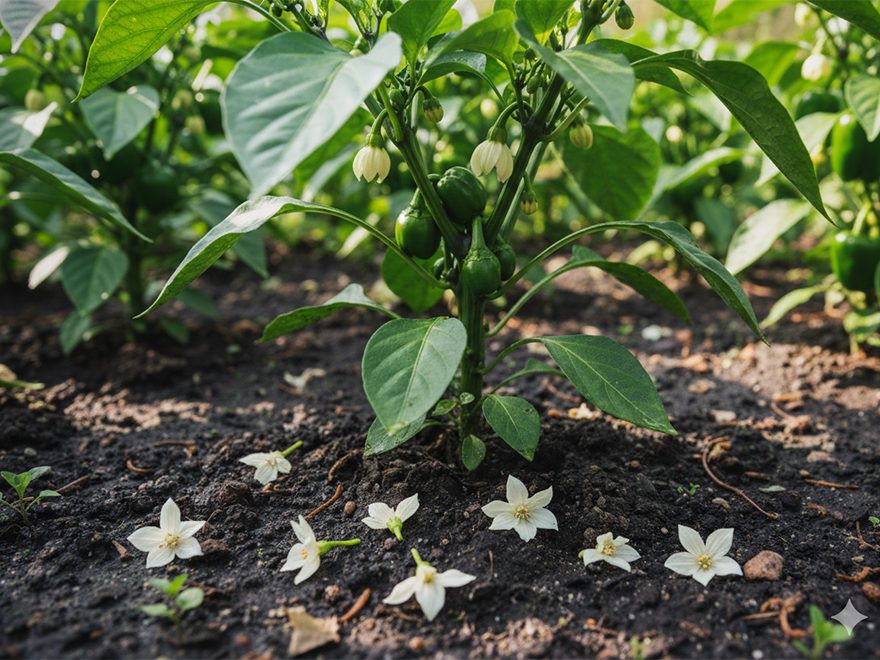
The pepper plant is covered in flowers. Then one morning half of them are on the ground. The ovaries that stay turn yellow and drop a week later. Or the tomatoes start fine, but the bottoms of the first fruit go soft and brown. The plant is trying to build fruit, and it does not have the calcium to do it. Calcium is the building block of cell walls — without enough of it at the exact moment fruit cells are dividing, those cells collapse. That is blossom end rot on tomatoes and ovary drop on peppers. Same mineral, same timing problem.
TL;DR: Dissolve 1 tablespoon of calcium nitrate in 2.5 gallons (10 liters) of water. Pour 2 cups (0.5 liters) at the base of each plant. Start when the first flowers open. Repeat every 10 to 14 days through fruit development. Works on peppers, tomatoes, eggplant, cabbage, and broccoli. Soil drench only — do not foliar spray at this concentration.
The recipe
You need
- Calcium nitrate: 1 tablespoon per 2.5 gallons (10 liters). Sold at garden centers in the fertilizer section. A 1 to 2 lb bag costs $8 to $10 and lasts the season.
- Water: 2.5 gallons (10 liters)
- A watering can or bucket
- A measuring spoon (1 tablespoon)
Do it
- Pour 2.5 gallons (10 liters) of water into a watering can or bucket.
- Add 1 tablespoon of calcium nitrate. Stir until fully dissolved. Calcium nitrate dissolves easily — the water stays clear.
- Use immediately or within a few hours.
How to use it
Soil drench (the only method at this dose):
Pour 2 cups (0.5 liters) of the solution at the base of each plant, onto the root zone. Water lightly first if the soil is dry. The calcium enters through the roots and moves upward to the developing fruit. For large plants in full production (mature tomatoes, loaded pepper bushes), use up to 1 quart (1 liter) per plant.
Schedule:
Start when the first flowers open. That is the moment calcium demand spikes — the plant is building new cell walls in the ovary, and it needs a steady supply. Repeat every 10 to 14 days through fruit development. Stop when harvest is finished.
Timing: Morning or evening. Avoid applying in temperatures above 90°F (32°C). The nitrogen in calcium nitrate can trigger a vegetative flush in heat — the plant pushes new leaves instead of feeding its fruit. On hot days, wait for a cooler stretch or switch to calcium acetate, which provides calcium without the nitrogen.
Pairing with Micronutrient Shield: Calcium nitrate provides nitrogen along with calcium. That nitrogen needs to be converted into plant proteins, not stored as nitrates in the fruit. The chelated iron drench helps — iron is the catalyst that converts nitrates into proteins. Apply an iron chelate drench midway between calcium nitrate applications for the cleanest fruit.
Which plants benefit most
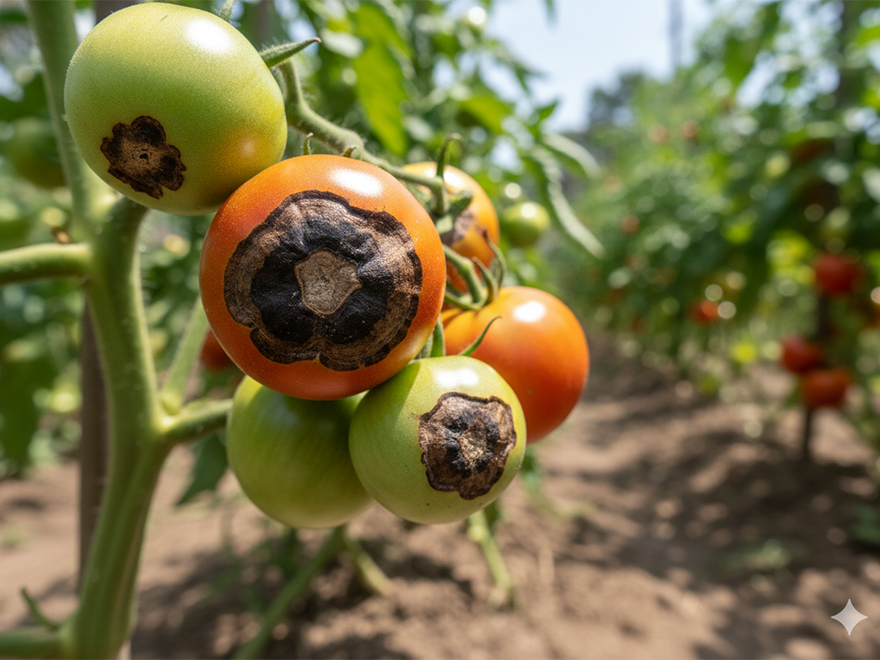
Best for: Peppers, tomatoes, and eggplant — the nightshade family that drops flowers and develops blossom end rot when calcium supply stutters. On peppers, it prevents ovary drop during heat stress. On tomatoes — the classic BER, where calcium cannot reach the fruit tip fast enough during rapid cell division. On eggplant — corky, brown patches on the blossom end. Drench every 10 to 14 days during fruiting. For alkaline soils, pair with a citric acid drench to make the calcium available.
Best for: Cabbage, broccoli, and cauliflower. These brassicas need calcium for head formation — a different mechanism than fruiting crops. Without it, cabbage gets internal tipburn and broccoli develops hollow stems. Drench every 10 to 14 days once head formation begins. Bonus: calcium nitrate slightly raises root zone pH, which helps prevent clubroot.
Good results: Cucumbers during heavy fruiting. They naturally exude organic acids that help grab soil calcium, but in alkaline soil or containers they can still fall short.
Not suited for: Leafy greens within 2 weeks of harvest (nitrogen accumulates as nitrates in leaves — use calcium acetate instead). Seedlings (the nitrogen pushes fast, leggy growth — wait until flowering). Above 90°F / 32°C (nitrogen triggers vegetative flushing instead of feeding fruit — use calcium acetate, which provides calcium without nitrogen).
Best for: Cabbage, broccoli, and cauliflower. These brassicas need calcium for head formation — a different mechanism than fruiting crops. Without it, cabbage gets internal tipburn and broccoli develops hollow stems. Drench every 10 to 14 days once head formation begins. Bonus: calcium nitrate slightly raises root zone pH, which helps prevent clubroot.
Good results: Cucumbers during heavy fruiting. They naturally exude organic acids that help grab soil calcium, but in alkaline soil or containers they can still fall short.
Not suited for: Leafy greens within 2 weeks of harvest (nitrogen accumulates as nitrates in leaves — use calcium acetate instead). Seedlings (the nitrogen pushes fast, leggy growth — wait until flowering). Above 90°F / 32°C (nitrogen triggers vegetative flushing instead of feeding fruit — use calcium acetate, which provides calcium without nitrogen).
Why it works
Calcium nitrate (Ca(NO₃)₂) delivers two things at once: calcium and nitrogen. Both are critical during fruit development, but for different reasons.
Calcium builds cell walls. Every new cell in a developing fruit needs calcium to form the pectin "glue" that holds cell walls together. When calcium supply drops — even for a day or two during rapid fruit growth — those cells form with weak walls. The weakest spot is the blossom end (the tip farthest from the stem), because calcium moves slowly through the plant and the tip is the last place it reaches. That is why blossom end rot always starts at the bottom of the fruit.
Nitrogen fuels the growth. A plant that is actively flowering and setting fruit needs nitrogen to build proteins, enzymes, and chlorophyll. Without enough nitrogen, the plant slows down and drops flowers it cannot support. Calcium nitrate supplies both needs in one drench.
The reason this is a soil drench and not a foliar spray at this concentration: calcium moves through the plant primarily in the xylem (the water-conducting tissue), which flows from roots to leaves. Foliar-applied calcium enters through the cuticle but cannot travel down to developing fruit effectively. Roots are the delivery route to the fruit.
Calcium nitrate is "moderate" on the bioavailability scale. Calcium acetate (made from wood ash and vinegar) is more bioavailable and carries no nitrogen. In practice, calcium nitrate is the go-to during normal weather because the nitrogen bonus helps fruiting. But in hot weather, the nitrogen is a liability — it pushes vegetative growth. Switch to calcium acetate when temperatures exceed 90°F.
What NOT to do
Do not apply in temperatures above 90°F (32°C). The nitrogen in calcium nitrate causes a vegetative flush in heat — the plant grows leaves instead of feeding fruit. Use calcium acetate in hot weather.
Do not combine with sulfate fertilizers in the same watering can. Mixing calcium nitrate with potassium sulfate, magnesium sulfate, or ammonium sulfate produces calcium sulfate (gypsum) precipitate — a white sludge that clogs your watering can and wastes both products. Apply them on separate days.
Do not combine with phosphorus fertilizers in the same tank. Calcium nitrate plus monopotassium phosphate or superphosphate creates insoluble calcium phosphate. Both nutrients become unavailable. If you need to apply phosphorus and calcium, space them at least 3 to 4 days apart. Adding citric acid (1 tsp per 10L) can help stabilize the solution if you must combine them, but separate applications are safer.
Do not foliar spray at this concentration. One tablespoon per 2.5 gallons is a soil drench rate. As a foliar spray, this concentration can burn leaves, especially in sun. If you want foliar calcium, use a dilute calcium acetate spray or a commercial foliar calcium product at the rate on the label.
Do not apply to seedlings. Calcium nitrate is too much nitrogen for seedlings. Wait until the plant is established and flowering — that is when calcium demand begins.
Do not apply to leafy greens within 2 weeks of harvest. Nitrates accumulate in leaf tissue. Root crops and fruiting crops convert nitrates to protein (especially with iron supplementation). Leafy greens store it as-is.
FAQ
What is the difference between calcium nitrate and calcium acetate for BER?
Both provide calcium. Calcium nitrate also provides nitrogen — useful during active fruiting, but risky in heat. Calcium acetate (from wood ash and vinegar) provides calcium without nitrogen — safer in hot weather and for leafy greens. In practice: use calcium nitrate during normal temperatures when plants are actively growing and fruiting. Switch to calcium acetate when temperatures exceed 90°F or when applying to leafy crops.
My peppers are dropping flowers but the soil test says calcium is fine. What else could it be?
Flower drop in peppers has multiple causes. Calcium deficiency is one, but heat stress (nighttime temps above 75°F), inconsistent watering, and over-fertilization with nitrogen also trigger it. If your soil calcium is adequate, the calcium nitrate drench may still help by providing a readily available form. But also check watering consistency — peppers drop flowers when the soil alternates between wet and dry.
Can I use gypsum instead of calcium nitrate?
Gypsum (calcium sulfate) provides calcium without nitrogen, which sounds good. But gypsum dissolves slowly and works over months, not days. It is a soil amendment, not a quick-fix drench. For immediate calcium delivery during active fruiting, calcium nitrate or calcium acetate works faster. Gypsum is better as a pre-season soil preparation.
How fast will I see results?
New fruit forming after the first application should develop without BER within 1 to 2 weeks. Fruit that already has blossom end rot will not recover — that damage is permanent. The goal is protecting the next wave of fruit. For pepper flower drop, you should see improved flower retention within one to two flowering cycles (7 to 14 days).
Can I use this on container plants?
Yes, and container plants benefit a lot from it. Container soil has a limited calcium reservoir, and frequent watering leaches what is there. A biweekly calcium nitrate drench keeps the supply steady. Use the same dose: 1 tablespoon per 2.5 gallons, 2 cups per large container.
Is there a gardening app that reminds me when to apply calcium nitrate?
Yes. The easyDacha garden planner app tracks growth stages and sends task reminders for feeding and protection at the right time. Downloadl at easydacha.com/download.
One tablespoon at the right moment

Calcium nitrate from the garden center. One tablespoon in a bucket of water. Pour it at the base when the first flowers open. That is the difference between a plant that drops its flowers and one that holds every fruit through harvest.
The easyDacha gardening app tracks nutrient schedules by growth stage so you feed at the right time, not when it is too late.
Try easyDacha app →. The garden planner app that plans your season in 60 seconds. Cancel anytime.
Related reading on easydacha.com
- How to Make Calcium Acetate from Wood Ash and Vinegar (Blossom End Rot Fix) — the nitrogen-free calcium alternative. Use this when temperatures exceed 90°F or on leafy greens.
- How to Use Citric Acid to Unlock Calcium and Magnesium in Soil (Mineral Mobilizer) — if calcium is in your soil but locked up, citric acid frees it. Pair with calcium nitrate for the full stack.
- How to Make DIY Chelated Iron from Iron Sulfate and Citric Acid (Iron Chlorosis Fix) — iron converts nitrates from calcium nitrate into plant proteins. Apply between calcium nitrate drenches.
- Simple Fertilizer Plan for Flowering Vegetables — the full feeding schedule. Calcium nitrate fits the flowering-to-fruiting phase.
- Starting Bell Peppers from Seed: Beginner Guide — get your peppers started right, then use this calcium drench when they flower.
- How to Identify Plant Diseases: Early Signs and What to Do — BER and flower drop mimic other problems. Confirm the diagnosis before treating.