
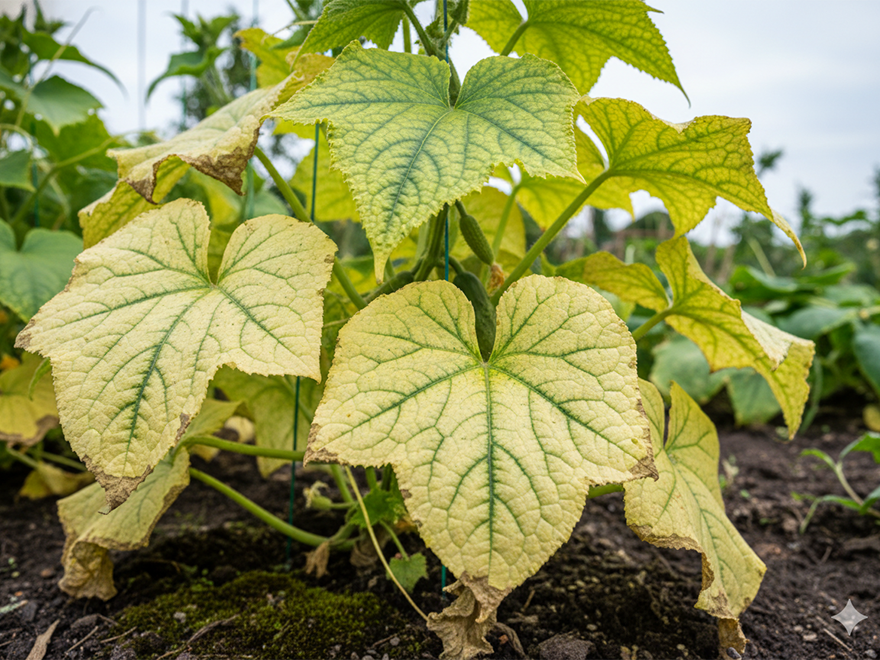
Yellow leaves with green veins. Starts at the top of the plant, on the newest growth. The rest of the plant looks fine. That pattern is iron chlorosis — the plant cannot pull iron from the soil even though there is plenty of it down there. Usually the problem is pH. In alkaline soil (above 7.0), iron locks into insoluble forms that roots cannot absorb. Commercial iron chelates fix it, but they cost $12 to $15 for a small jar. You can make the same thing for pennies with iron sulfate and citric acid from the grocery store.
TL;DR: Dissolve 1/2 teaspoon of iron sulfate (ferrous sulfate) and 1/2 teaspoon of citric acid powder in 1 gallon (3.8 liters) of water. Stir until fully dissolved. Drench the soil around affected plants or spray foliage. Repeat every 14 to 21 days. Greens up yellow leaves within 1 to 2 weeks. Works on cucumbers, tomatoes, peppers, blueberries, and anything showing iron chlorosis.
The recipe
You need
- Iron sulfate (ferrous sulfate): 1/2 teaspoon per gallon. Sold at garden centers as "iron sulfate" or "copperas," and at pharmacies as "ferrous sulfate." A 1 lb bag costs $4 to $6 and lasts an entire season. Pharmacy tablets work too — crush one 325 mg tablet per gallon (contains ~65 mg elemental iron).
- Citric acid powder: 1/2 teaspoon per gallon. Sold in the grocery baking aisle or on Amazon. A 1 lb bag costs $4 to $5 and lasts years.
- Water: 1 gallon (3.8 liters)
- A watering can or spray bottle
- A measuring spoon (1/2 teaspoon)
Do it
- Pour 1 gallon (3.8 liters) of water into a watering can or bucket.
- Add 1/2 teaspoon of citric acid powder. Stir until fully dissolved. The citric acid slightly acidifies the water, which helps the iron stay in soluble form.
- Add 1/2 teaspoon of iron sulfate. Stir until dissolved. The solution turns pale yellow-green. That color is iron citrate — a chelated form of iron that roots can absorb directly.
- Use immediately. The solution is most effective fresh. Iron starts oxidizing within a few hours and the chelate weakens over time.
How to use it
Soil drench (main method):
Pour about 1 cup (250 ml) of the solution at the base of each plant, onto the root zone. Water lightly first if the soil is dry. Iron citrate dissolves in water and reaches roots immediately. For larger plants like tomatoes and cucumbers, use 2 cups (500 ml) per plant.
Foliar spray (faster response):
Pour the solution into a spray bottle. Spray the undersides and tops of yellowing leaves. Foliar iron absorbs through the leaf surface and greens up faster than soil drenching — sometimes within 3 to 5 days. Use a fine mist. The citric acid in the spray also creates a mildly acidic leaf surface that discourages some fungal spores.
Schedule:
Repeat every 14 to 21 days during active growth. For preventive use in alkaline soils, start when plants have 4 to 6 true leaves and continue through fruit development. Iron chlorosis tends to get worse as plants grow bigger and demand more iron.
Timing: Apply in the morning or evening. Avoid midday sun — the iron solution can leave temporary spots on leaves if it dries too fast in direct heat.
Which plants benefit most
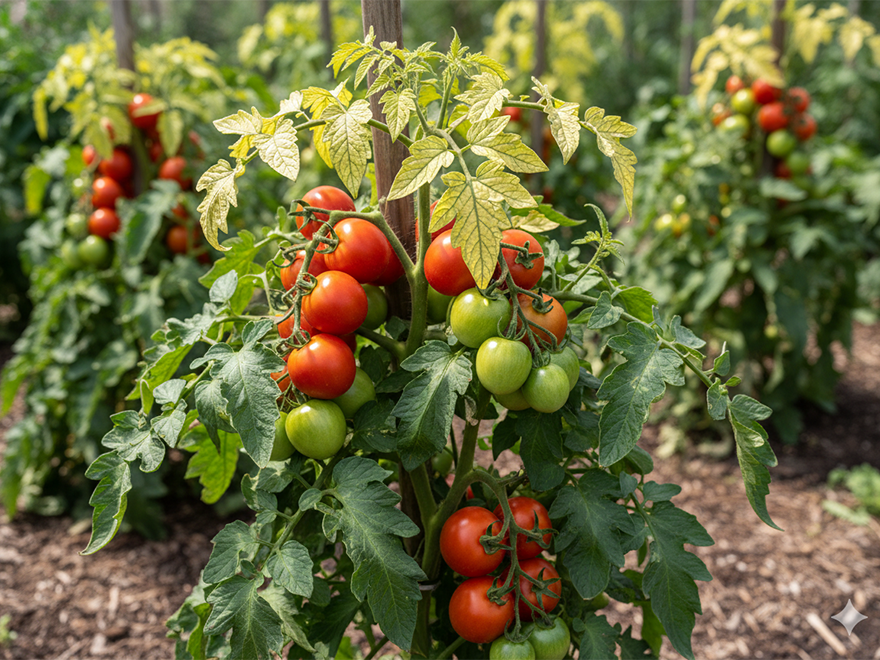
Best for: Cucumbers, tomatoes, peppers, and eggplant — any fast-growing vegetable in alkaline or compacted soil. Iron chlorosis shows as yellowing between the veins on the newest leaves, and it hits cucumbers first because they grow the fastest. On tomatoes, the drench also reduces nitrate accumulation in fruit — iron catalyzes the conversion of nitrates into plant proteins, which means better shelf life. Container plants benefit most because tap water pushes soil pH up over time.
Good results: Blueberries, hydrangeas, raspberries, and strawberries. Acid-loving plants in neutral or alkaline soil almost always show iron chlorosis. A drench every 2 to 3 weeks keeps them green. Also helps beans and peas in heavy clay soils where iron availability drops after rain.
Not needed for: Corn, root vegetables in acidic soil, herbs like basil and mint. These crops rarely suffer iron deficiency at normal soil pH (6.0 to 7.0). If your soil is already acidic, adding more iron can cause toxicity — brown leaf spots and stunted roots.
Good results: Blueberries, hydrangeas, raspberries, and strawberries. Acid-loving plants in neutral or alkaline soil almost always show iron chlorosis. A drench every 2 to 3 weeks keeps them green. Also helps beans and peas in heavy clay soils where iron availability drops after rain.
Not needed for: Corn, root vegetables in acidic soil, herbs like basil and mint. These crops rarely suffer iron deficiency at normal soil pH (6.0 to 7.0). If your soil is already acidic, adding more iron can cause toxicity — brown leaf spots and stunted roots.
Why it works
Iron exists in most garden soil. The problem is not shortage but availability. At pH above 7.0, iron forms insoluble oxides and hydroxides that roots cannot absorb. The plant starves for iron while sitting in iron-rich soil.
Citric acid solves this by chelating the iron. "Chelate" comes from the Greek word for claw — the citric acid molecule wraps around the iron ion and holds it in a soluble, plant-available form. Without chelation, iron sulfate added to alkaline soil would immediately lock up again, wasted.
Here is what happens in the bucket. Ferrous sulfate (FeSO₄) plus citric acid (C₆H₈O₇) produces ferrous citrate — an organic iron complex that stays soluble across a wider pH range than plain iron sulfate. Roots absorb ferrous citrate directly through the cell membrane. Leaves can absorb it through stomata and the cuticle.
This is the same principle behind commercial EDDHA and DTPA iron chelates. The difference is cost. Commercial chelates use synthetic chelating agents and run $12 to $15 per application. DIY citric acid chelation costs about 10 to 20 cents per gallon.
The "anti-nitrate" bonus is a separate mechanism. Iron is a cofactor in the enzyme nitrate reductase, which converts nitrate (NO₃⁻) into ammonium (NH₄⁺) inside the plant, which then gets built into amino acids and proteins. When iron is deficient, nitrates accumulate in leaves and fruit instead of being converted. Root crops with high nitrates rot faster in storage. A late-season iron chelate drench — especially on beets, carrots, and potatoes — reduces nitrate accumulation and extends shelf life.
What NOT to do
Do not exceed the recommended dose. More iron is not better. Iron overdose causes brown spots on leaves, root damage, and can trigger manganese and zinc deficiency by competitive uptake. Stick to 1/2 teaspoon of each per gallon. If you are making a larger batch (2.5 gallons / 10 liters), use 1 teaspoon of each.
Do not apply on the same day as calcium treatments. Iron and calcium compete for root uptake. If you are using calcium acetate for blossom end rot, space the two drenches at least 3 to 4 days apart.
Do not apply to waterlogged soil. In anaerobic (oxygen-starved) conditions, iron converts to its ferrous (Fe²⁺) form at toxic concentrations. If your soil is soggy, fix drainage first, then treat for chlorosis.
Do not store the mixed solution. Iron oxidizes in water within hours. The pale green solution turns rusty orange as ferrous iron (Fe²⁺) becomes ferric iron (Fe³⁺), which plants cannot absorb. Always mix fresh.
Do not use on plants that prefer alkaline soil (lavender, lilac, asparagus). These plants do fine at high pH and do not need iron supplementation. Adding iron with citric acid temporarily acidifies the root zone, which these species dislike.
Do not confuse iron chlorosis with nitrogen deficiency. Nitrogen deficiency yellows the oldest (bottom) leaves first. Iron chlorosis yellows the newest (top) leaves first, with veins staying green. Wrong diagnosis means wrong treatment. If bottom leaves are yellow, try whey-ammonia nitrogen drench instead.
FAQ
How do I know if my plant has iron chlorosis or something else?
Iron chlorosis has a specific look: yellow tissue between veins that stay green, starting on the newest leaves at the top of the plant. This is called interveinal chlorosis. If the whole leaf turns yellow (veins and all), it is probably nitrogen. If old leaves yellow first, it is nitrogen or magnesium. If leaves have brown spots or edges, it could be potassium, sunburn, or disease. Start with the plant disease identification guide to narrow it down.
Can I use iron sulfate without citric acid?
You can, but it is less effective. In neutral or alkaline soil, plain iron sulfate oxidizes and locks up within hours. The citric acid keeps the iron in a soluble chelated form so roots have time to absorb it. Without citric acid, you need to apply much more iron sulfate to get the same result, which increases the risk of iron toxicity and soil acidification.
Where do I buy iron sulfate?
Garden centers, hardware stores in the garden section, or Amazon. A 4 lb bag costs $6 to $10 and treats hundreds of gallons. If you cannot find garden-grade iron sulfate, pharmacy ferrous sulfate tablets (325 mg) work — crush one tablet per gallon. Avoid "iron chelate" products with EDDHA or DTPA if you want to save money — that is what you are making yourself with this recipe.
How fast will I see results?
Foliar spray: 3 to 5 days for visible greening. Soil drench: 7 to 14 days. The speed depends on how severe the deficiency is and whether the underlying cause (usually high pH) is addressed. If your soil pH is 8.0 or higher, the iron chelate helps the current crop, but you should also work on long-term pH reduction with sulfur or acidic organic matter.
Can I use this on container plants?
Yes, and container plants benefit the most. Tap water in many US regions is alkaline (pH 7.5 to 8.5), and over time it raises container soil pH until iron becomes unavailable. A monthly iron chelate drench prevents chlorosis in containers. Use the same 1/2 teaspoon of each per gallon recipe.
Is there a gardening app that reminds me when to apply iron chelate?
Yes. The easyDacha garden planner app tracks growth stages and sends task reminders for feeding and protection at the right time. Download at easydacha.com/download.
Two ingredients, two minutes

Iron sulfate from the garden center, citric acid from the baking aisle. Half a teaspoon of each in a gallon of water. That is a chelated iron solution that fixes yellow leaves, helps fruit store longer, and costs less than a dollar per batch. The commercial version of this runs $15 a jar.
The easyDacha gardening app tracks nutrient schedules by growth stage so you feed at the right time, not when you remember.
Try easyDacha app →. The garden planner app that plans your season in 60 seconds. Cancel anytime.
Related reading on easydacha.com
- How to Make Calcium Acetate from Wood Ash and Vinegar (Blossom End Rot Fix) — another DIY mineral solution for a different deficiency. Space iron and calcium drenches 3-4 days apart.
- How to Make Ammonium Lactate from Whey and Ammonia (Bio-Available Nitrogen) — if bottom leaves are yellowing, the problem is nitrogen, not iron. This fixes nitrogen deficiency from kitchen scraps.
- How to Identify Plant Diseases: Early Signs and What to Do — iron chlorosis mimics other problems. This guide helps you tell them apart before treating.
- How to Make Horsetail Decoction for Natural Silicon (Stronger Cell Walls) — silicon works alongside iron to strengthen plant tissue. Both are micronutrient treatments that complement each other.
- Simple Fertilizer Plan for Flowering Vegetables — the full feeding schedule. Iron chelate fits into the micronutrient layer of a balanced feeding plan.
- How to Make Bioavailable Phosphorus Fertilizer from Bones (Citric Acid Method) — citric acid chelates phosphorus too. Same grocery store ingredient, different mineral unlocked.