
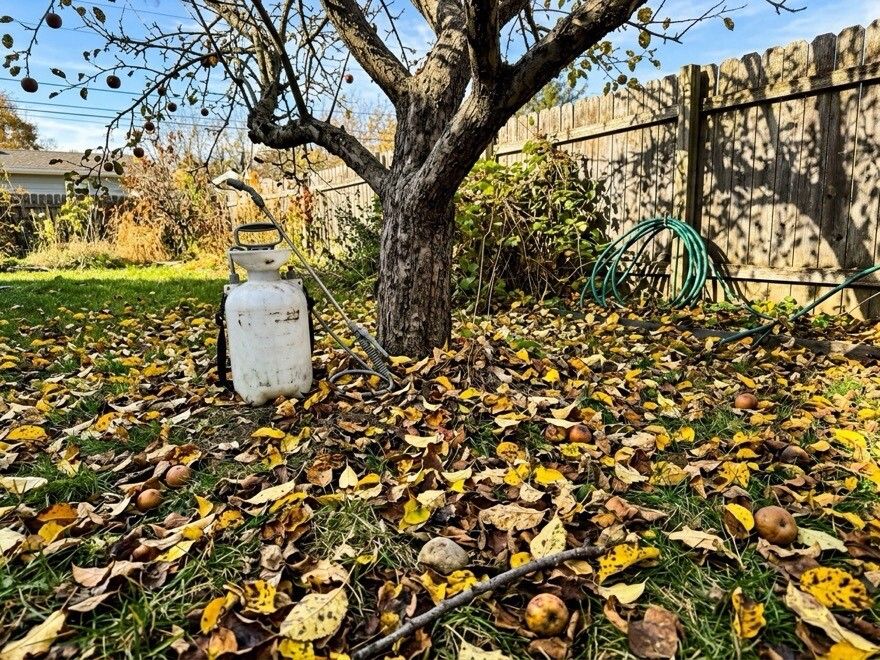
You pick the apples, rake a little, and by May the spotted leaves are back. Apple scab survives winter in the leaves on the ground. When spring rain comes, it shoots spores up into the new growth. A fall urea spray for apple scab goes after that leaf litter, so there is less to launch. Urea feeds the microbes that rot the leaves, and rotted leaves release fewer spores. If you are not sure it is scab, check our guide to identifying plant diseases first.
TL;DR: Mix 6.4 oz (180 g) of urea per gallon of water for a fall urea spray on apple scab. Spray the fallen leaves right after leaf drop.
The recipe: fall urea spray for apple trees
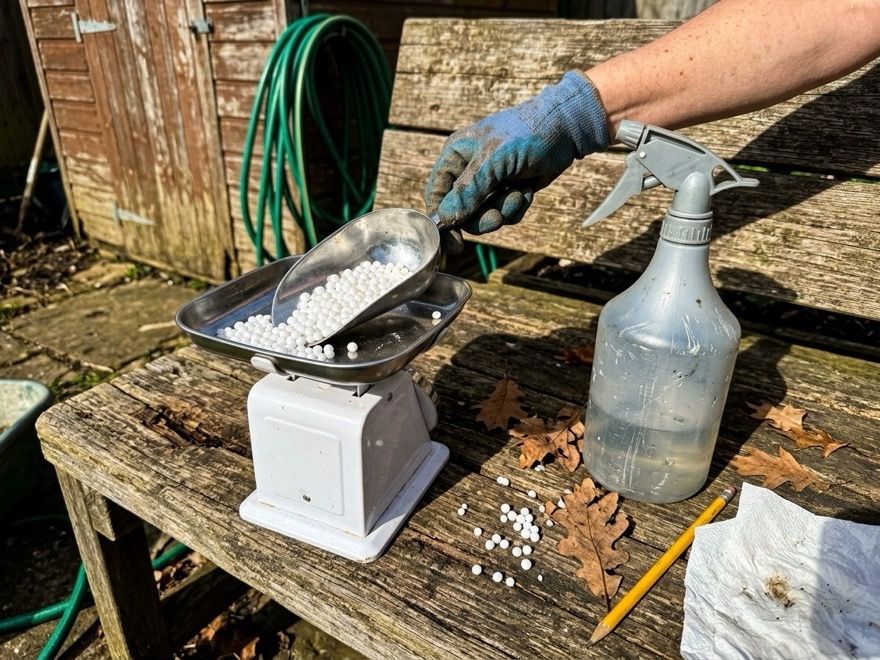
Use 6.4 oz (180 g) of plain urea fertilizer per gallon (3.8 L) of water. That is the university rate of 40 pounds of urea in 100 gallons of water per acre, scaled down. One gallon wets about 435 square feet (40 m²) of leaf litter.
For 1 gallon (3.8 L) of water:
- 6.4 oz (180 g) urea fertilizer, 46-0-0. Buy it at a garden center or farm supply store. The bag should say urea and nothing else. Weigh it on a kitchen scale, because cups of prills vary.
- 1 gallon (3.8 L) of warm water. Cold water dissolves the prills slowly. Cornell advises hot water when you mix in cold weather.
Mix it:
- Pour the water into a clean plastic sprayer.
- Add the urea and shake until no prills remain.
- Spray it the same day.
Shelf life: mix only what you will use that day.
A home tree with a 15-foot (4.5 m) canopy sits over about 175 square feet (16 m²), so half a gallon covers it. Spray out to the drip line, which is the circle under the outer branches.
How to apply it
Spray the fallen leaves just after leaf drop, when most of the leaves are on the ground. Purdue Extension says to apply urea just before or immediately after leaf fall. Rutgers lists the apple scab cleanup window as leaf drop in fall.
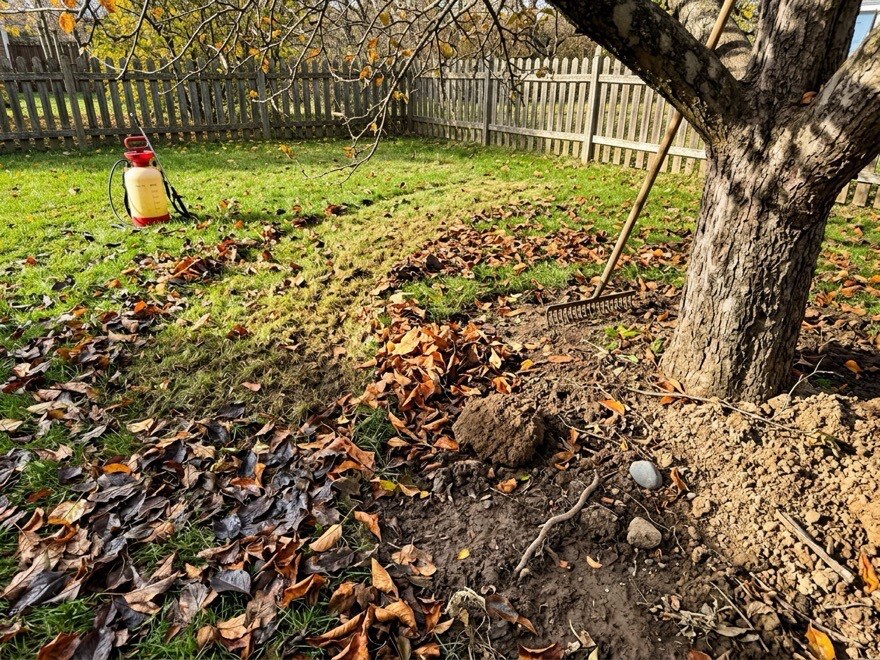
Mow or rake the leaves into a loose layer first. Rutgers says that combining urea with mowing after leaf drop gives the biggest cut in spring scab spores. Then spray the leaf litter on the ground, not the tree. Wet the leaves evenly, including the ones piled against the trunk.
You can also spray leaves still on the tree, but only if they will drop within 7 days. Cornell and Michigan State both warn that otherwise the tree absorbs the nitrogen and less reaches the leaf litter.
Leaf drop comes earlier in USDA zone 4 and zone 5 and later in USDA zone 7 and zone 8. Watch the tree, not the calendar. Think of it as a urea spray for leaf drop: it works on leaves that are already down. If you miss the fall window, Cornell says a spray on fallen leaves in spring still works, up to green tip. Green tip is when the first small tips of green show on the buds.
Why a fall urea spray works on scab
Urea speeds up leaf rot. Cornell explains that urea on the orchard floor stimulates microbes that break down overwintering leaves. Leaves that rot by spring cannot launch many spores.
Cornell also gives a realistic target. No method removes every spore, but any one of the proven methods can cut spore production by 80 percent or more. Those methods are urea, shredding the leaves, lime, or raking the leaves away.
It is a pressure reducer, not a cure. Cornell says it works best with a well-timed spring spray program. It pays off mostly in orchards that had scab the year before. For the spring part, see our pink bud spray guide.
Is this spray safe to handle?
Yes, with normal care. Urea is a common fertilizer, but a strong solution can irritate skin and eyes, and the extra nitrogen can wash into water.
- Wear gloves and eye protection. Add long sleeves when you pump and spray.
- Flush the sprayer afterward. Cornell notes that urea is caustic and can corrode a sprayer pump over time.
- Keep it off ponds, streams, wells, and storm drains. Do not spray where it can run off.
- Keep kids and pets out of the area until the spray has dried.
- Plan next year's feeding. Spray that lands under the canopy adds nitrogen, so Cornell says to adjust your normal nitrogen rate.
Do not use a stronger mix. No extension source supports higher rates.
What NOT to do
Do not drench the branches. The tree takes up the nitrogen. Late nitrogen can extend growth and slow cold hardening, which Cornell flags for young trees.
Do not replace cleanup with the spray. Rake or mow first. Extension tests found the best results from combining the two.
Do not spray after the ground freezes. Michigan State notes that late fall urea works less well when hard frost and snow follow quickly, because leaf breakdown slows in the cold.
Do not use it on a certified organic orchard. Urea is not allowed there. Rutgers suggests raking or mowing the leaves and spreading a light layer of compost. Cornell lists dolomitic lime as another option.
Best for which plants
How to stop apple scab for good is a long game, and a fall urea spray for fruit trees is one step in it. Here is where it fits.
- Apple and crabapple trees with a scab history: the main target of a fall urea spray on fruit trees. Spots on the leaves and olive-brown patches on fruit are the signs.
- Young apple trees: spray the leaf litter only and keep the spray off the bark and branches.
- Trees that had no scab last year: skip it. Cornell says these cleanup steps have no value there.
- Vegetable beds, evergreens, and lawns: keep the spray away from them.
Leaf drop sneaks up on you. In easyDacha you can add your apple tree as a custom plant. Every custom plant gets its own care plan and task list. Your next two weeks of tasks are tied to your ZIP code, so fall cleanup stays on the list. Use Notes to log the day you sprayed and whether scab showed up in spring. This garden planner app turns a one-time chore into a yearly routine. See also our guide to a personalized garden planting schedule. Try easyDacha →
When scab keeps coming back
If scab returns after a clean fall, check three things. First, did you miss leaves under shrubs or along the fence? Second, is the canopy open enough to dry fast after rain? Prune for light and airflow. Third, is the variety susceptible? Resistant varieties are the strongest long-term fix. On susceptible trees with a scab history, spring sulfur from green tip until petal fall helps. Copper at silver tip is another tool, covered in our Bordeaux mixture recipe. For other cleanup sprays in the dormant window, see our liquid glass dormant spray guide and the bleach and MKP sanitizer post.
Put Leaf Drop on Your Calendar
Mixing urea is the easy part. Catching the week when the leaves fall is harder. easyDacha is a garden planner app built around your ZIP code, with a task list for the next two weeks. Add your tree, and keep fall cleanup from slipping.
FAQ
Does a fall urea spray stop apple scab?
It lowers scab pressure but does not stop it. Cornell says urea on fallen leaves, like other cleanup methods, can cut spore production by 80 percent or more. You still need good airflow and, on susceptible trees, a spring spray program.
When should I spray urea on apple trees in fall?
Spray just before or right after leaf drop. Leaves still on the tree should drop within 7 days of spraying. If you miss fall, a spray on fallen leaves in spring works up to green tip.
How much urea do I mix per gallon for apple scab?
Mix 6.4 oz (180 g) of urea fertilizer per gallon (3.8 L) of water. This is the 40 pounds in 100 gallons per acre rate used by Cornell and Rutgers, scaled to one gallon.
Should I spray the tree or the leaves on the ground?
Spray the fallen leaves on the ground. Extension advice for a fall urea spray on fruit trees warns that nitrogen sprayed on branches goes into the tree instead of the leaf litter.
Is there an app that helps me remember fall orchard jobs?
Yes. easyDacha is a gardening app that builds a care plan and a two-week task list for each plant, including custom plants like fruit trees. Its Notes feature lets you record your spray date.