
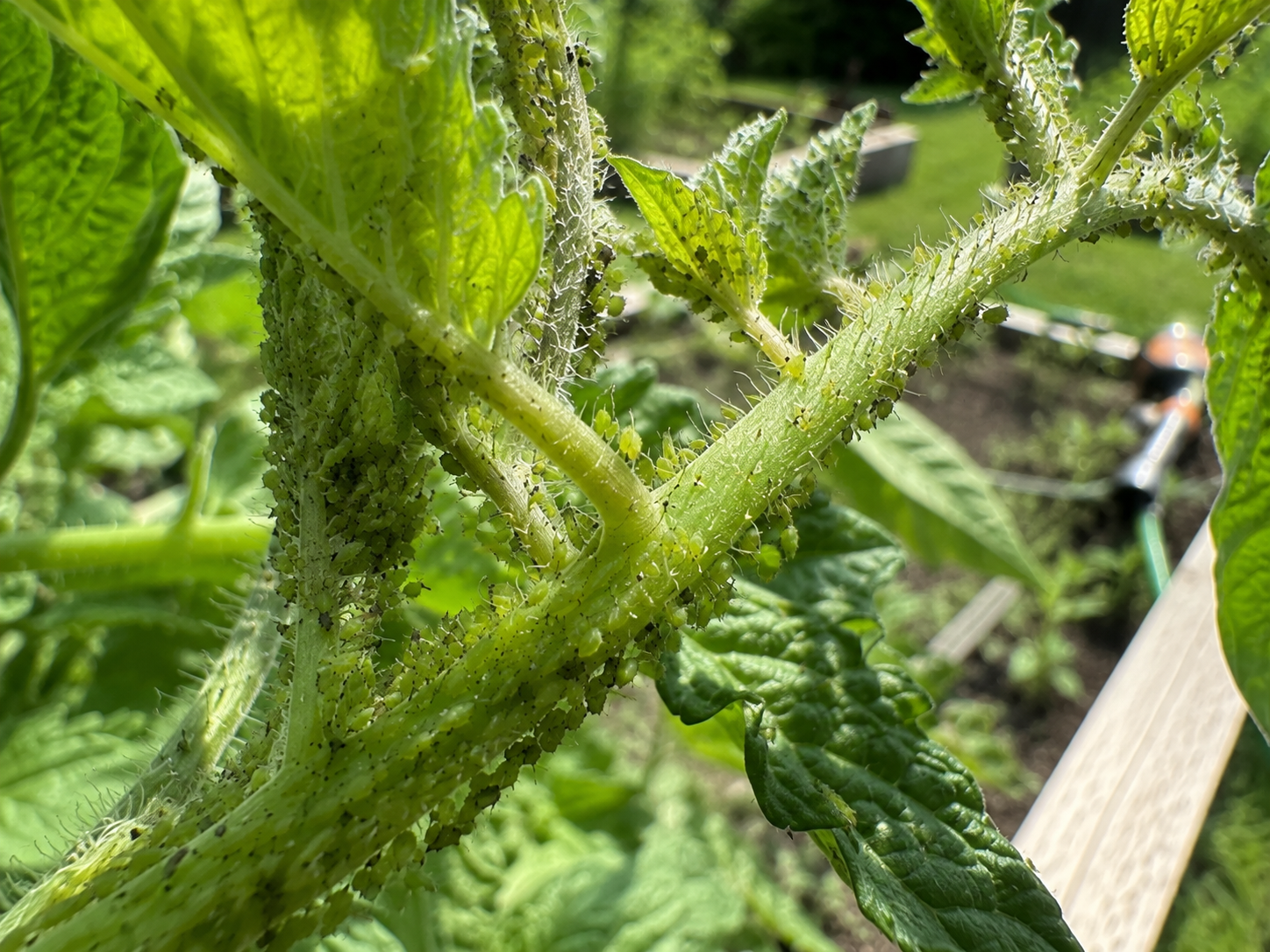
You walk outside, flip a tomato leaf, and the underside is covered in tiny green or black dots. They're clustered on new growth, on flower buds, on the stems of your peppers. Your plants look sticky, curled, and stunted. That's aphids, and they multiply fast. If you want to get rid of aphids organically, three sprays applied in the right order will clear them out without harming bees or your harvest. Most gardeners reach for one product and hope. The method below uses all three together, because aphids build resistance to a single treatment within weeks.
TL;DR: Get rid of aphids organically by spraying neem oil weekly, rotating in spinosad every 10 days, and applying Beauveria bassiana as a biological follow-up to prevent colonies from rebuilding.
How to spot aphids on your plants
Aphids are soft-bodied insects, about 1/16 to 1/8 inch (1.5 to 3 mm) long. They cluster on the undersides of leaves, on new shoots, and around flower buds. Colors range from pale green and yellow to black, red, and white, depending on the species.
Check for these signs before you even see the bugs. Leaves curling inward, especially on new growth. A shiny, sticky film on leaf surfaces (that's honeydew, their excrement). Black sooty mold growing on the honeydew. Ants marching up and down stems in a steady line. Ants farm aphids for the honeydew, so an ant trail on your plants is often the first clue.
The worst damage happens fast. A single aphid can produce 80 offspring in a week without mating. In warm weather (above 70°F / 21°C), a small cluster becomes a full infestation in 7 to 10 days. If you see them, act the same day. The top 10 most common garden pests guide covers other insects you might confuse with aphids, including whiteflies and thrips.
The spray recipe
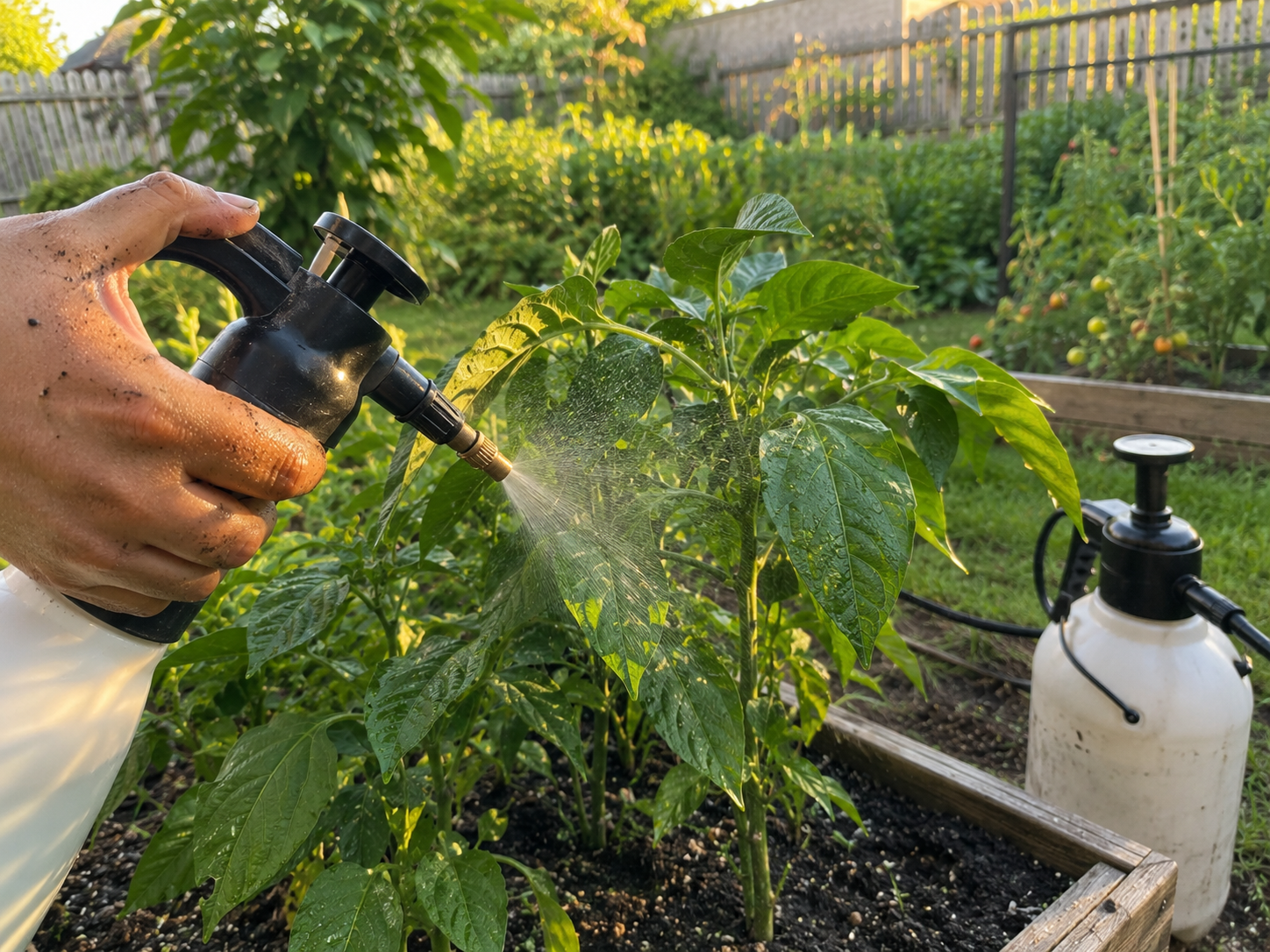
This is a 3-product rotation. You don't mix them together. You alternate them on a schedule.
Spray A: Neem oil
For 1 gallon (3.8 L) of water:
- 2 teaspoons (10 ml) cold-pressed neem oil (garden centers or online)
- 1 tablespoon (15 ml) unscented liquid castile soap (grocery store)
Shake hard before each spray. Neem oil separates from water within minutes.
Spray B: Spinosad
For 1 gallon (3.8 L) of water:
- Follow the label rate on your spinosad concentrate (typically 2 to 4 tablespoons / 30 to 60 ml per gallon, but products vary)
- Spinosad is a naturally derived insecticide from soil bacteria (Saccharopolyspora spinosa). Look for "spinosad" as the active ingredient at garden centers.
Spray C: Beauveria bassiana
For 1 gallon (3.8 L) of water:
- Follow the label rate on your Beauveria bassiana product (online garden supply, look for "Beauveria bassiana" as the active ingredient)
- Add 1 tablespoon (15 ml) unscented liquid castile soap as a surfactant
- Beauveria is a beneficial fungus that infects and kills aphids on contact. If you're curious about growing your own, here's a guide to making Beauveria bassiana at home.
How to apply
Start with a hard blast of plain water from the hose. This physically knocks off 70 to 80% of aphids. They can't fly back up. Do this every morning for the first three days.
On day one, after the water blast dries (about 30 minutes), spray neem oil on all affected plants. Cover both sides of every leaf, stems, and especially new growth where aphids cluster. Spray in the evening, after bees have stopped foraging. Neem degrades in direct sunlight, so evening application gives it a full night to work.
On day 7, switch to spinosad. Same coverage rules. Spinosad kills on contact and through ingestion, so aphids that survive the neem will pick it up. Apply in the evening. Spinosad is toxic to bees while wet, but safe once dry (about 3 hours).
On day 14, apply Beauveria bassiana. Spray in the evening. Beauveria spores germinate on the aphid's body and kill it over 3 to 5 days. The dead aphid then releases more spores that infect nearby aphids. UV light destroys Beauveria spores, so evening application is critical.
Repeat this 3-spray rotation (neem, spinosad, Beauveria) every 7 days for at least 3 full cycles. After that, check plants every 3 days. If you still see aphids, run another full cycle. A garlic spray between cycles adds a repellent layer that discourages new colonies from settling.
Why rotation works
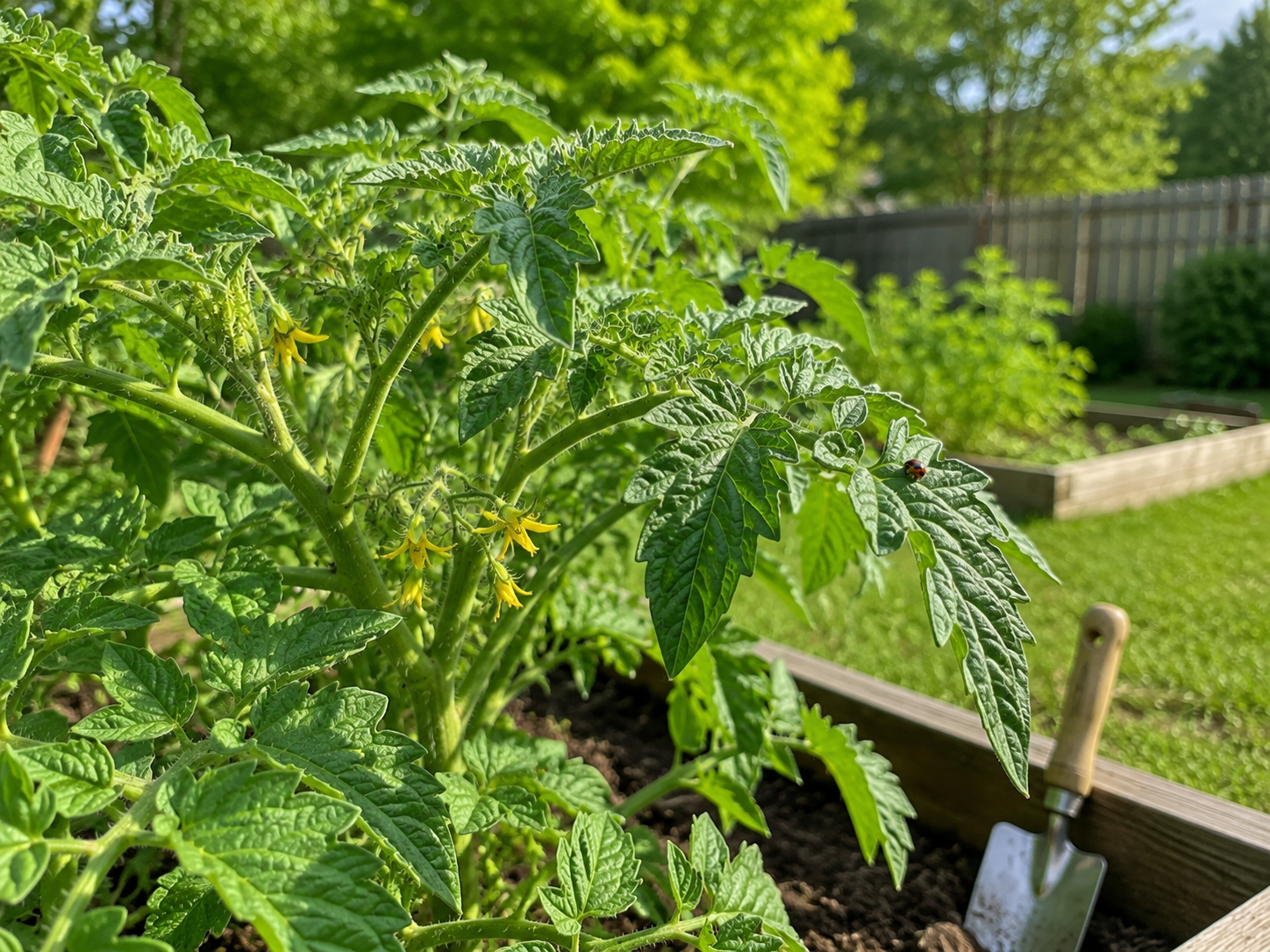
Aphids reproduce so fast that a single-product approach fails within a few generations. A colony exposed to neem oil every week will develop partial resistance in 4 to 6 weeks. Rotation prevents this.
Neem oil works as an anti-feedant and growth disruptor. It doesn't kill aphids instantly. Instead, it prevents them from molting and reproducing. Aphids that feed on neem-treated leaves stop producing offspring within 24 hours.
Spinosad attacks the nervous system through a different pathway. It causes involuntary muscle contractions. Aphids that survived neem because of partial resistance are still vulnerable to spinosad because the two products target different biological systems.
Beauveria bassiana is biological, not chemical. The fungal spores physically penetrate the aphid's exoskeleton and grow inside the body. There's no chemical resistance mechanism against a living organism colonizing you from the outside. Beauveria also keeps working after you stop spraying because the spores persist on leaf surfaces for 5 to 7 days in shade.
What to do when these three stop working
If you've run three full rotation cycles and aphids are still building colonies, step up. This is rare but happens with heavy infestations in hot, humid weather (USDA zone 8, zone 9, zone 10, Gulf Coast and Southeast).
Insecticidal soap is a direct-contact kill. Mix 5 teaspoons (25 ml) of potassium-based insecticidal soap per 1 gallon (3.8 L) of water. Spray directly onto aphid clusters. The soap dissolves the waxy coating on their bodies. It only works wet, so thorough coverage matters. Garden centers stock this in the organic pest control section.
Pyrethrin (not permethrin) is a botanical extract from chrysanthemum flowers. It's a last-resort organic option because it also kills beneficial insects, including ladybugs and lacewings that eat aphids. Spray in the evening after pollinators are done. Follow the label rate. Use once, then switch back to the 3-spray rotation. This is your homemade organic pesticide escalation path.
Ladybugs and lacewings are the long-term answer. A single ladybug eats 50 aphids per day. Buy them at garden centers or online and release at dusk (they fly away in daylight). Plant dill, fennel, yarrow, or sweet alyssum nearby to keep them around. This works best as a prevention strategy after you've knocked the population down with sprays.
Which plants get hit hardest
Nightshades (tomatoes, peppers, eggplant): Aphids target new growth and flower clusters. On peppers, heavy infestations cause flower drop and misshapen fruit. Check the undersides of top leaves weekly starting in late spring.
Cucurbits (squash, cucumbers, melons): Melon aphids (Aphis gossypii) specialize in this family. They transmit cucumber mosaic virus, which causes mottled, distorted leaves. Once the virus infects a plant, nothing cures it. Fast aphid control is the only prevention.
Brassicas (kale, cabbage, broccoli, Brussels sprouts): Cabbage aphids (Brevicoryne brassicae) hide deep in leaf folds and curled heads. They're harder to reach with sprays. For kale, focus on spraying the undersides of lower leaves where colonies start. A fermented mustard spray works well as a repellent between treatments.
Herbs (basil, dill, cilantro, parsley): Aphids love tender herb stems. Spray with neem in the evening and harvest in the morning. Wait 24 hours after spinosad before harvesting herbs you plan to eat fresh.
Roses and ornamental flowers: If aphids are on your flowering plants near the vegetable garden, treat those too. Aphids migrate. A bee-safe aphid spray for flowering plants covers the timing rules for spraying near blooms.
Is this safe for my vegetables?
Yes. The USDA National Organic Program approves all three products (neem oil, spinosad, Beauveria bassiana) for organic food production.
Neem oil breaks down within 1 to 3 days on leaf surfaces. Spinosad degrades in sunlight within 24 hours. Beauveria bassiana only infects insects, not mammals or plants. Wash vegetables before eating, as you always should.
Follow these rules:
- Spray in the evening, not morning, to protect pollinators.
- Wait 24 hours after spinosad before harvesting leafy greens or herbs you eat fresh.
- Don't spray neem oil when temperatures exceed 90°F (32°C). It can burn leaves in extreme heat.
- Don't mix neem oil with conventional fungicides. They deactivate Beauveria spores.
What NOT to do
Don't squish aphids with your fingers and leave them. Crushed aphids release alarm pheromones that trigger winged aphids to fly to new plants. Knock them off with water or kill them with spray.
Don't spray in the middle of the day. Bees are foraging, neem burns in sun, spinosad kills bees while wet, and Beauveria spores die in UV light. Every product works better in the evening.
Don't ignore the ants. Ants protect aphid colonies from predators and carry aphids to new plants. If you see ants on your stems, the aphid problem will keep returning. Apply a ring of diatomaceous earth around the plant base to block ant access.
Don't spray once and stop. A single spray kills 80 to 90% of visible aphids. The remaining 10 to 20% repopulate the plant within a week. Three full rotation cycles (21 days minimum) is what it takes.
Stop guessing when to spray and let your garden plan do it

The hardest part of aphid control isn't mixing the spray. It's remembering the follow-up. Which product did you use last week? When is the next application? Did you check the peppers?
easyDacha is a vegetable garden app that builds a 7-day task calendar for your exact garden. Pest monitoring tasks are tied to your actual beds and plants, so you get a reminder before the problem spirals. No spreadsheets, no guesswork.
Try easyDacha app →. Plan your garden in 60 seconds, cancel anytime.
FAQ
How fast do aphids multiply?
One aphid can produce 80 offspring in a week. In warm weather above 70°F (21°C), females give live birth without mating. A small cluster of 10 aphids becomes over 1,000 in two weeks if untreated. That's why same-day action matters when you first spot them.
Can I mix neem oil and spinosad together in one spray?
No. Use them on separate days in a rotation. Mixing products doesn't improve effectiveness and can create a solution that's harder for plants to tolerate. The rotation approach also prevents aphids from building resistance to either product.
Will neem oil hurt my tomato plants?
Neem oil is safe for tomatoes when applied in the evening at temperatures below 90°F (32°C). In extreme heat, the oil can trap heat on leaf surfaces and cause burns. If your area is in a heat wave, switch to spinosad or Beauveria for that week and come back to neem when temperatures drop.
Do ladybugs really work for aphid control?
Yes, but timing matters. Release them at dusk after you've already knocked the aphid population down with sprays. If you release ladybugs into a massive infestation, they'll eat what they can and then fly away. Reduce the population first, then bring in ladybugs to handle the stragglers and prevent recolonization.
What's the sticky stuff on my plant leaves?
That's honeydew, a sugary excretion from aphids. Black sooty mold often grows on top of it. The mold itself doesn't infect the plant, but it blocks sunlight from reaching the leaf. Wipe it off with a damp cloth after you've eliminated the aphids. Rain washes it away naturally over time.
Is there an app that helps schedule pest treatment sprays?
Yes. easyDacha is a garden planner app that builds your care plan week by week, including pest monitoring tasks tied to your specific beds and plants. Instead of trying to remember which spray to use on which day, the 7-day task calendar keeps the rotation on track automatically.
Are aphids worse in certain USDA zones?
Aphids thrive in warm, moderate climates. Gardeners in USDA zone 7, zone 8, and zone 9 (Southeast, Gulf Coast, lower Midwest) typically see the heaviest infestations because mild winters let overwintering eggs survive. In USDA zone 5 and zone 6 (Northern US, Mountain West), hard freezes kill most eggs, so spring infestations start later and smaller.