
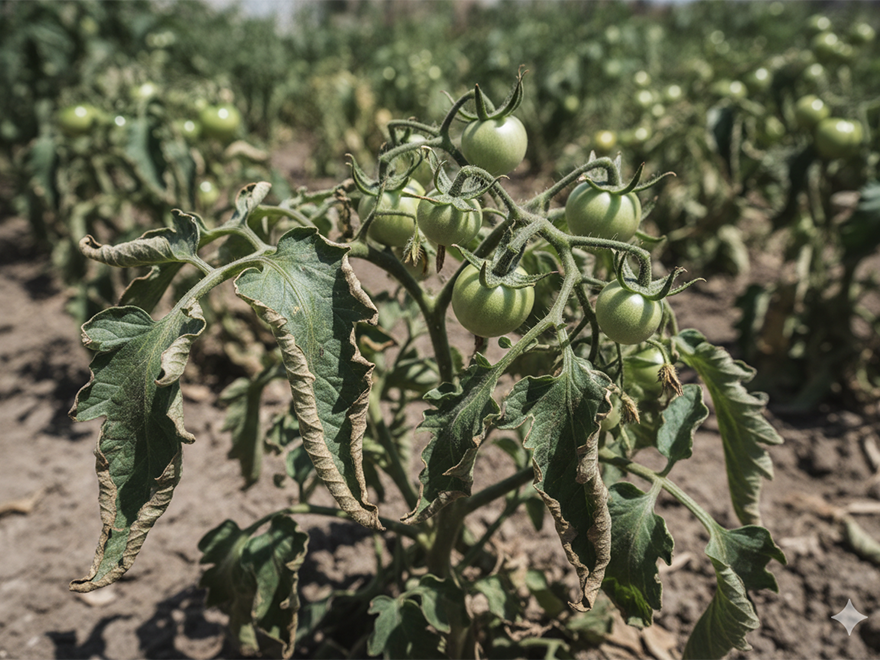
The leaf edges brown first. They curl inward, then crisp. The fruit sets but stays small and bland — no sweetness, no crunch, no color. Tomatoes taste watery. Cucumbers go soft a day after picking. The plant has enough leaves and enough flowers, but the fruit cannot finish. That is potassium deficiency, and it hits hardest right when the plant is loading fruit and needs potassium the most.
TL;DR: Dissolve 1 tablespoon of potassium nitrate in 2.5 gallons (10 liters) of water. Spray the foliage — tops and undersides of leaves — in the evening. The potassium absorbed through the leaves sends a metabolic signal to the root system that doubles its uptake rate of soil potassium. Repeat every 10 to 14 days during fruiting. Works on cucumbers, tomatoes, peppers, squash, melons, and strawberries. Foliar only at this concentration.
The recipe
You need
- Potassium nitrate (KNO₃): 1 tablespoon per 2.5 gallons (10 liters). Sold at garden centers as "potassium nitrate" or in the hardware store as "stump remover" — check the label to confirm the active ingredient is potassium nitrate (KNO₃). A 1 lb container costs $5 to $8 and lasts the season.
- Water: 2.5 gallons (10 liters)
- A spray bottle or pump sprayer
Do it
- Pour 2.5 gallons (10 liters) of water into a bucket or sprayer tank.
- Add 1 tablespoon of potassium nitrate. Stir until fully dissolved. The water stays clear — potassium nitrate dissolves easily.
- Pour into a spray bottle or pump sprayer. Use immediately or within a few hours.
How to use it
Foliar spray (the only method at this dose):
Spray the tops and undersides of all leaves until dripping wet. Potassium absorbs through the leaf surface — both the upper cuticle and the stomata on the undersides. A fine mist gives better coverage than a heavy stream.
This is a foliar-only recipe. At 1 tablespoon per 2.5 gallons, the concentration is calibrated for leaf absorption, not soil drenching. A soil drench at this dose would deliver too little potassium to the root zone to matter. The power of this recipe is the signaling effect — potassium hitting the leaves tells the root system to ramp up its own potassium absorption from the soil.
Schedule:
Start when fruit development begins — for tomatoes, that is when the first green fruit appears. For cucumbers, when the first ovaries swell. For peppers, when flowers begin setting fruit. Repeat every 10 to 14 days through harvest.
Timing: Evening only. Spray after the sun is low or the plants are in shade. Potassium nitrate solution on leaves in direct sun causes leaf burn — the droplets concentrate as they evaporate and scorch the tissue. Evening application gives the plant all night to absorb the spray through open stomata.
Pairing with other treatments: Space potassium nitrate spray at least 3 to 4 days from calcium treatments (calcium nitrate or calcium acetate). Potassium and calcium compete for uptake channels — applying both on the same day reduces the effectiveness of each. The Micronutrient Shield (iron + Epsom salt) can be mixed in the same tank with potassium nitrate if needed, but separate applications are cleaner.
Which plants benefit most
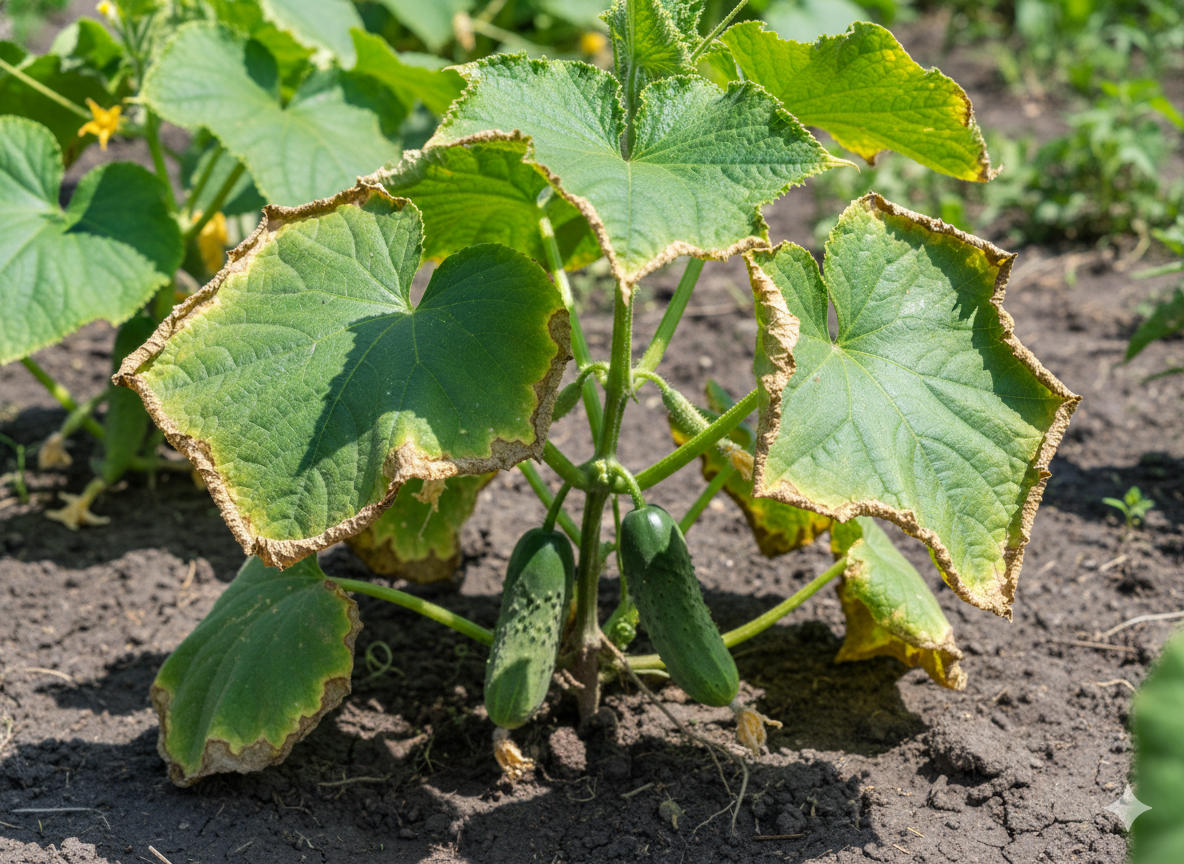
Best for: Cucumbers, tomatoes, peppers, eggplant, squash, melons, and strawberries — any fruiting crop during active production. Potassium drives sugar transport from leaves to fruit. Brown, crispy leaf edges during heavy fruiting are the classic sign that potassium is running out. On tomatoes, low potassium means watery, bland fruit. On peppers — thin walls and pale color. On cucumbers — soft fruit that goes bad fast. Container plants benefit the most because their soil potassium reservoir is small. Late-season tomato spray (September) also works as a ripening accelerator (see FAQ below).
Good results: Garlic and onions during bulbing. After removing the garlic scape, a potassium nitrate spray stimulates bulb expansion.
Not suited for: Seedlings or plants before flowering — the nitrogen pushes leaf growth instead of roots. Leafy greens within 2 weeks of harvest — nitrates accumulate in leaf tissue. Legumes (beans, peas) — excess nitrogen inhibits their nitrogen-fixing bacteria.
Good results: Garlic and onions during bulbing. After removing the garlic scape, a potassium nitrate spray stimulates bulb expansion.
Not suited for: Seedlings or plants before flowering — the nitrogen pushes leaf growth instead of roots. Leafy greens within 2 weeks of harvest — nitrates accumulate in leaf tissue. Legumes (beans, peas) — excess nitrogen inhibits their nitrogen-fixing bacteria.
Why it works
This recipe exploits a feedback loop between leaves and roots that agronomists call the "Leaf-to-Root" potassium synergy.
Here is what happens. When potassium enters the leaf through foliar absorption, it integrates into the plant's phloem (the sugar-conducting tissue). The sudden increase in leaf potassium concentration sends a hormonal signal down to the root system. The roots respond by upregulating their potassium transport proteins — essentially opening more channels for potassium uptake from the soil. The result: the root system doubles its absorption rate of soil-applied potassium.
This is why the recipe works better than just adding more potassium to the soil. Soil potassium has to dissolve, move through the soil solution, and reach the root surface — all of which takes time and depends on soil moisture, pH, and clay content. Foliar potassium bypasses all of that and gets into the plant within hours. And then it amplifies soil potassium uptake on top of it. Two access routes running simultaneously.
Potassium itself does several things inside the plant. It controls the opening and closing of stomata (the pores on leaves), which regulates water loss and CO₂ intake. It activates over 60 enzymes involved in photosynthesis and sugar transport. And — most relevant for fruit quality — it drives the translocation of sugars from the leaves (where they are made) to the fruit (where they accumulate as sweetness, color, and storage compounds). When potassium is low, sugars stay in the leaves and the fruit stays bland.
The marginal chlorosis pattern is diagnostic. Potassium is a mobile nutrient — when the plant runs short, it pulls potassium from older leaves to feed new growth and fruit. The older leaves die from the edges inward: brown, crispy margins that curl up. If you see that pattern moving up the plant during fruiting, potassium is the problem.
What NOT to do
Do not spray in direct sunlight. This is the most common mistake. Potassium nitrate solution on leaves in full sun causes concentrated salt burns as the droplets evaporate. Always spray in the evening or on a cloudy day. If the sun is still hitting the plants, wait.
Do not use as a soil drench at this concentration. One tablespoon per 2.5 gallons is a foliar rate. As a soil drench, this amount of potassium is too dilute to make a difference in the root zone. The value of this recipe is the leaf absorption and the root-signaling effect.
Do not exceed 1 tablespoon per 2.5 gallons (10 liters). Higher concentrations burn leaves. If you are making a smaller batch (1 gallon / 3.8 liters), use 1 teaspoon.
Do not apply to seedlings or early-stage plants. The nitrogen in potassium nitrate stimulates leaf growth. Before flowering, you want root and structural development, not a flush of soft new leaves.
Do not apply to leafy greens within 2 weeks of harvest. Nitrates from potassium nitrate accumulate in leaf tissue. Fruiting crops convert nitrates to protein (especially with iron supplementation). Leafy crops store them as-is.
Do not combine with calcium treatments on the same day. Potassium and calcium compete for the same uptake channels in root cell membranes. Applying both simultaneously causes each to block the other. Space them at least 3 to 4 days apart.
Do not use potassium nitrate in autumn. Dormant plants cannot absorb nitrate nitrogen. In autumn, nitrates leach into groundwater instead of feeding the plant. For autumn potassium, use potassium sulfate or potassium chloride (for chlorine-tolerant crops) instead.
FAQ
How do I know if my plants need potassium?
The signature pattern is marginal chlorosis on older leaves — yellow or brown edges that crisp and curl inward, starting at the bottom of the plant and moving up. The center of the leaf stays green at first. Fruit that sets but stays small, pale, or bland is another sign. If both symptoms show up during fruiting, potassium is almost certainly the problem. The plant disease identification guide helps you distinguish potassium deficiency from other problems that brown leaf edges (sunburn, salt damage, calcium deficiency).
Where do I buy potassium nitrate?
Garden centers sell it as "potassium nitrate" in the fertilizer section. Hardware stores sell it as "stump remover" — check the label to confirm the active ingredient is potassium nitrate (KNO₃) with no additives. A 1 lb container costs $5 to $8 and treats dozens of spray batches. Online garden supply stores carry it in bulk.
Can I use potassium nitrate to speed up ripening?
Yes. There is a "Nitrate Shock" protocol for end-of-season ripening acceleration. Combine 1 tablespoon of potassium nitrate with 100 ml of 9% vinegar (or 2 grams of succinic acid) in 2.5 gallons (10 liters) of water. Spray foliage. This triggers the metabolic signals that accelerate pigment development and sugar accumulation in peppers and tomatoes. Use this in September when frost is approaching and you need green fruit to ripen fast.
What is the difference between potassium nitrate and potassium sulfate?
Potassium nitrate (KNO₃) provides potassium plus nitrogen. It is best during active growth and fruiting when plants can use both. Potassium sulfate (K₂SO₄) provides potassium plus sulfur, with no nitrogen. It is better for autumn soil application (nitrogen would leach), for plants that already have enough nitrogen, and for crops sensitive to excess nitrogen. For summer foliar spraying during fruiting, potassium nitrate is the better choice because the nitrogen bonus helps fruit development.
Can I mix this with other foliar sprays?
You can mix potassium nitrate with iron chelate and Epsom salt (the Micronutrient Shield) in the same spray tank. Do not mix with calcium-based sprays — they precipitate. Do not mix with phosphorus fertilizers — potassium nitrate plus monopotassium phosphate in a concentrated tank mix can cause precipitation. Apply them on separate days.
Is there a gardening app that tracks when to apply potassium foliar spray?
Yes. The easyDacha garden planner app tracks growth stages and sends task reminders for feeding at the right time. Download at easydacha.com/download.
One tablespoon, two uptake routes

Potassium nitrate from the garden center or hardware store. One tablespoon in a bucket of water. Spray the leaves in the evening. The potassium hits the leaves directly and tells the roots to pull twice as much from the soil. Better fruit, better flavor, better storage — for the cost of a few cents per batch.
The easyDacha gardening app tracks nutrient schedules by growth stage so you feed at the right time, not when it is too late.
Try easyDacha app →. The garden planner app that builds your full care schedule. Cancel anytime.
Related reading on easydacha.com
- How to Make the Micronutrient Shield (Iron Chelate + Epsom Salt) to Prevent Nitrate Buildup — the companion treatment. Iron converts the nitrates from potassium nitrate into plant proteins. Apply between K sprays.
- How to Use Calcium Nitrate to Stop Flower Drop and Protect Fruit (Ovary Protection) — calcium for cell walls, potassium for sugar transport. Space them 3-4 days apart.
- How to Make Potato Peel Ferment for Potassium-Hungry Plants (Free K Fertilizer) — an organic potassium source from kitchen scraps. Good for soil application between foliar sprays.
- Simple Fertilizer Plan for Flowering Vegetables — the full feeding schedule. Potassium nitrate foliar spray fits the fruiting phase.
- How to Identify Plant Diseases: Early Signs and What to Do — potassium deficiency mimics other leaf problems. Confirm the diagnosis before treating.
- How to Use Citric Acid to Unlock Calcium and Magnesium in Soil (Mineral Mobilizer) — unlocks soil-bound minerals. Citric acid frees calcium and magnesium the same way this spray frees potassium through root signaling.